Project Director: J Scott Janusch
In 2017 Hawaii Symphony principal oboist J. Scott Janusch asked LMA to become fiscal sponsor for an exciting new project. As his gift to the Hawaii community that has nurtured his professional musical career, Scott directed the creation of a new oboe made of native Hawaiian kauila wood, and also commissioned a new musical composition featuring the kauila oboe. The oboe was constructed by Howarth’s of London, and Jon Magnussen, noted Hawaii composer and professor of music at University of Hawaii West Oahu, composed the new work.
The new oboe was received in December 2018, and Magnussen’s new composition was performed in April and May 2019. Scott performed these first concerts introducing the kauila oboe, presented in chamber form by Chamber Music Hawaii and Live Music Awareness, and in symphonic form by the Hawaii Symphony. LMA retains ownership of the instrument, seeing to its ongoing care and maintenance, and controlling its use for concert and educational purposes.
In 2023 the kauila oboe found a permanent home at the University of Hawaii at Manoa Music Department, where it will be available for appropriate use by UH faculty, students, and other community artists at the University’s discretion. With UH as its caretaker, the kauila oboe’s unique voice will continue to be heard far into the future.


Here is a video of Scott introducing the completed Hawaiian kauila oboe. It looks and sounds gorgeous!
THE KAUILA OBOE COMPOSITION COMPETITION
The kauila oboe is tied to Hawaii in many ways – biologically, ecologically, culturally, and socially – but most of all, musically. The first work written especially for this oboe, Nā Kau ‘Elua by Dr. Jon Magnussen of University of Hawaii-West Oahu, inspired a competition among UH-Manoa composition students to also write for the instrument.
The KAUILA OBOE COMPOSITION COMPETITION was announced in 2025, and many excellent compositions were entered. Four prizes were awarded, and a recital featuring all four winning works was presented by Alex Hayashi, oboe faculty at UH-Manoa, with Megumi Kurachi, piano, on Monday April 6, 2026, at University of Hawaii Orvis Auditorium, Honolulu, Hawaii.
Each of the works was beautifully conceived and evocative of Hawaiian nature and culture. Here is what the winners had to say about their works:
Chants, lullabies, and dances (Dalen Wuest, Honorable Mention)
200-300 years ago, a tree began growing on the island of Kauaʼi. It heard countless songs, saw countless dances, and witnessed the rise and fall of the Hawaiian Kingdom. A portion of this wood traveled to London, where it was fashioned into a one-of-a-kind instrument, the only oboe in the world made from Kauila wood.
Musically, Chants, lullabies, and dances is connected to Hawaiʻi in a few ways. First, the piano part is inspired by and extrapolated from drumming rhythms I transcribed from the 1974 album, Mele Inoa ‒ Authentic Hawaiian Chants. Many of the oboeʻs melodic phrases loosely reference some Hawaiian songs, especially in melodic contour. Musical aspects not specifically influenced by Hawaiian music and culture include the approach to pitch material, which is primarily based on pentatonic collections, usually with the oboe and each piano staff drawing from a different scale, often with a different tonic. In combining a variety of influences in this way, I have attempted to honor the culture of islands I find myself living, working, and studying on, while remaining true to my own modernist sensibilities. It is my hope that this blend has yielded something that is interesting and rewarding, for listeners and performers alike.
When the Wood Breathes (JunYi Chow, 3rd Prize)
When the Wood Breathes draws on the inflection and pacing of mele chanting—not as a literal representation, but as an impression shaped by my four years of living in Hawai‘i. The piece responds to the idea of the Kauila Oboe as an instrument born from a 300-year-old tree and to the themes of renewal and continued life that the instrument symbolizes. Rather than recreating traditional practices, it reflects my own imaginative view of Hawai‘i’s energy and movement.
The music moves through moments of quiet reflection, restless searching, and renewed vitality. It begins with a brief calling idea that leads into an intimate, speech-like tone—more whispered than sung—before opening into lines that stretch, hesitate, and breathe with a gentle, expressive quality.
As the piece unfolds, the material becomes more active and eventually reaches a fast, rhapsodic section. Percussive gestures—including key clicks that imitate the character of pū‘ili and stamping used for musical emphasis—expand the sonic palette and contribute to the sense of energetic motion, without intending to replicate traditional practice.
He mai kuhewa (Joseph Williams, 2nd Prize)
In la’au lapa’au (traditional Hawaiian medicine), the kauila tree holds an important role. Shavings from its trunk can be mixed with water and consumed to treat kūhewa (heart failure, stroke or apoplexy) among other conditions. While dominant in forests of past, the kauila is critically endangered and its medicinal usage limited. Meanwhile, heart disease and stroke remain leading causes of death among Kānaka Maoli, a people enduring land dispossession, socioeconomic disparities, cultural prostitution and generational trauma.
He mai kuhewa is a piece that portrays a common human condition: wrestling with and healing from an illness. The first movement invites both performers to tap into emotions associated with any serious medical diagnosis: numbness, shock, vulnerability, confusion, fear, anger, suspicion, guilt, stagnation, denial, anxiety, reflection, determination and hope. Rubato (the expressive push and pull of tempo) is welcome throughout the piece at the interpreters’ discretion; some passages should be expressed strictly in time while others can blow in the wind. The second movement symbolizes the bodyʼs renewal and imagines an ʻāina (land) where nā kauila (the kauila trees) live in abundance. It should flow, trickle and splash with a joyful innocence. Be present to the beauty of life.
Return to Kauila (Paul Cosme, Grand Prize)
Kauila is the name of both the Hawaiian endemic tree and the Hawaiian turtle goddess who guides and protects children. The hard and dark tree now critically endangered was versatilely used by the Kānaka Maoli (Native Hawaiians) as tools, weapons, and musical instruments. On the other hand, Kauila, the goddess, was born out of a dark egg, colored like Kauila wood, and became the protector of children who play along her shores. When she is sleeping under the water, children would see bubbles rising. At times, Kauila would transform into a girl so she could play with the children.
This piece is a homage to both Kauilas, the tree and the goddess. The musical textures emulate the uses of this wood: as pointed tools, sharp weapons, or percussive and melodic instruments. The piece’s form loosely portrays the goddess playing with children, her submersion and slumber in the waters, and her eventual emergence and return to the children she vowed to protect before she goes back again deep in the water. Throughout the piece, the minor third serves as an important sonic marker as an allusion to the Hawaiian mele. A variety of musical traditions are also echoed to recognize the multiculturalism that now constitutes Hawaiʻi’s children.
The piece, as its title suggests, echoes the goddess Kauila’s promise to return and, in many ways, also affirms the hope for the Kauila tree, and by extension the Kānaka Maoli, to return flourishing in their own home.
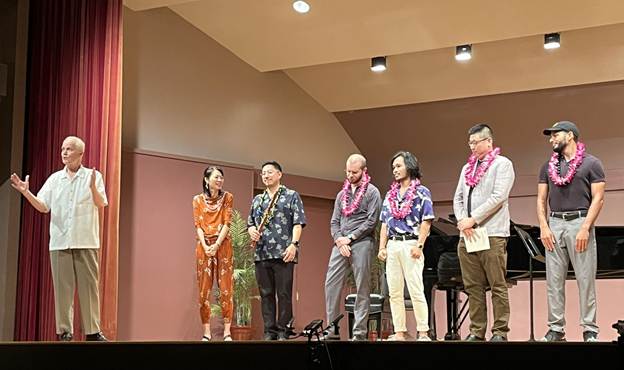
L to R: Scott Janusch, Megumi Kurachi, Alex Hayashi, Dalen Wuest, Paul Cosme, JunYi Chow, Joseph Williams.
Live Music Awareness produced a 4-minute “sizzle reel” as a prelude to the next phase of the Hawaiian Oboe Legacy Project — a 30-minute video documentary describing the stages of the kauila oboe’s creation, from the forests of Koke’e, to Mickey Sussman’s workshop, to Howarth’s of London where the oboe was built, to the concert stage where the tree is alive and singing once again.
Here’s a taste of the video art that will be forthcoming in the near future:
https://drive.google.com/file/d/1z-9LUzcFtT5TuwxVjmTNG7Spg4VJ7ElW/view?usp=sharing
The Hawaiian Oboe Legacy Fund was established to provide for the ongoing care and maintenance of the one-of-a-kind kauila wood oboe produced by the Hawaiian Oboe Legacy Project. Your donations are most welcomed. To contribute to this exciting project, please visit the DONATE page and indicate your support for the Hawaiian Oboe Legacy Fund. Mahalo!